The Power of Stillness: Why Isometric Exercise Is Your Secret Weapon Against Aging
When most people conceptualize resistance training, they picture motion: plates clanging on a barbell, deep repetitions on a leg press, or explosive kettlebell swings. I’ve explored bodyweight training routines and functional movement patterns, yet one of the most clinically potent tools for physical longevity and systemic resilience involves no visible movement at all: isometric exercise.
In this article, I’ll provide a breakdown of the physiological mechanisms behind isometric exercise, the clinical literature supporting its longevity benefits, and a straightforward full-body routine you can implement anywhere.
What Is Isometric Exercise?
Isometric exercise involves contracting a muscle without changing its length or moving the joint. Unlike dynamic exercises (like squats or bicep curls) where muscles lengthen and shorten through a range of motion, isometric exercises involve static contraction—holding a position under tension without movement.
Think of pushing against a wall that won’t move, holding a plank, or maintaining a squat position at a fixed depth. Your muscles are firing at full capacity, but nothing is budging.
Muscular contractions fall into three categories:
- Concentric: The muscle shortens under tension (e.g., ascending in a squat or lifting a curl).
- Eccentric: The muscle lengthens while resisting a load (e.g., lowering down in a push-up).
- Isometric: The muscle generates tension against an immovable resistance or in a fixed posture without changing its length, leaving the joint static.
Isometrics are divided into two main sub-modalities:
- Yielding Isometrics (Holding): Resisting an external force or gravity to maintain a static joint position (such as holding a wall sit or a plank).
- Overcoming Isometrics (Pushing/Pulling): Exerting maximal or near-maximal force against an immovable object (such as pressing upward into a locked doorway or pulling against an anchored strap).
Because there is zero acceleration and minimal joint excursion, isometrics produce high muscular tension and neural activation while virtually eliminating the shearing forces and impact loads that frequently exacerbate joint inflammation.
Why Isometrics Are Crucial for Healthy Aging
1. Combatting Sarcopenia
Sarcopenia—the age-related loss of muscle mass and strength—is one of the most significant threats to independence and quality of life as we age. Research consistently shows that resistance training is essential for maintaining muscle mass in older adults, but isometric training offers unique advantages.
A systematic review and meta-analysis found that isometric strength training is a “potentially safer, more accessible and more effective alternative” for older adults with sarcopenia. Unlike dynamic resistance training, isometrics eliminate the risk of dropping weights or losing control during eccentric movements—major concerns for aging populations.
Research published in The Journal of Physiology demonstrated that neuromuscular adaptations remain responsive with age and structured isometric training effectively improves motor neuron recruitment in older adults without exposing vulnerable joints to destructive shear forces.
2. Superior Blood Pressure Reduction
Perhaps the most compelling evidence for isometric exercise comes from cardiovascular research. A systematic review and meta-analysis published in Hypertension Research found that isometric resistance training lowers systolic blood pressure, diastolic blood pressure, and mean arterial pressure—with effects larger than those previously reported for dynamic aerobic or resistance training.
UCLA Health summarized findings from an analysis of 270 studies involving over 15,000 adults, concluding that isometric exercise produced the most favorable effects on blood pressure compared to all other exercise modalities.
As analyzed in Examine.com’s Study Breakdown on Blood Pressure and Exercise, the primary driver of this effect is reactive hyperemia. During sustained isometric contraction, mechanical pressure from the contracted muscle temporarily blocks blood flow locally. When the hold terminates and the muscle relaxes, blood rushes back in at high volume. This rapid stress triggers a massive release of endothelial nitric oxide, signaling the arterial walls to dilate and gradually improving arterial flexibility.
3. Joint-Friendly Strength Building
As we age, joint health becomes paramount. Isometric exercises allow you to position the joint in an optimal, pain-free mid-range angle. This allows you to apply meaningful muscular loading that still leads to building strength.
4. Anabolic Resistance Countermeasures
One reason age-related muscle loss accelerates is “anabolic resistance”. This is a phenomenon where aging muscle becomes less responsive to growth signals. Isometric training at high intensities creates the mechanical tension necessary to overcome this resistance, stimulating muscle protein synthesis even when dynamic training becomes difficult.
5. Accessibility and Safety
Isometric exercises require minimal equipment and can be modified for any fitness level. This aligns perfectly with our philosophy of maintaining wellness goals regardless of circumstances. Whether you’re traveling, recovering from injury, or working with limited space, isometrics provide a viable strength training stimulus.
6. Tendon Remodeling
Tendons lose tensile stiffness and cellular hydration with age, increasing the risk of chronic tendinopathy and tendon tears. To stimulate collagen synthesis, tendons require sustained mechanical strain under time and load.
Research shows that heavy isometric holds can reduce tendon pain by up to 86% for over 45 minutes post-exercise, making them valuable for managing tendinopathies common in older adults.
Isometric Exercise For Everyone
While isometric exercise is great for aging, here are some additional reasons you may want to incorporate them even if you’re already following a more rigorous training regime.
- Strength Gains: Research indicates isometric training produces strength gains of 5-10% per week in beginners, with improvements seen across all age groups.
- Muscle Hypertrophy: A study in the Journal of Strength and Conditioning Research found that muscle lean mass increased by 3.1% with isometric training, comparable to isotonic training.
The Full-Body Basic Isometric Routine
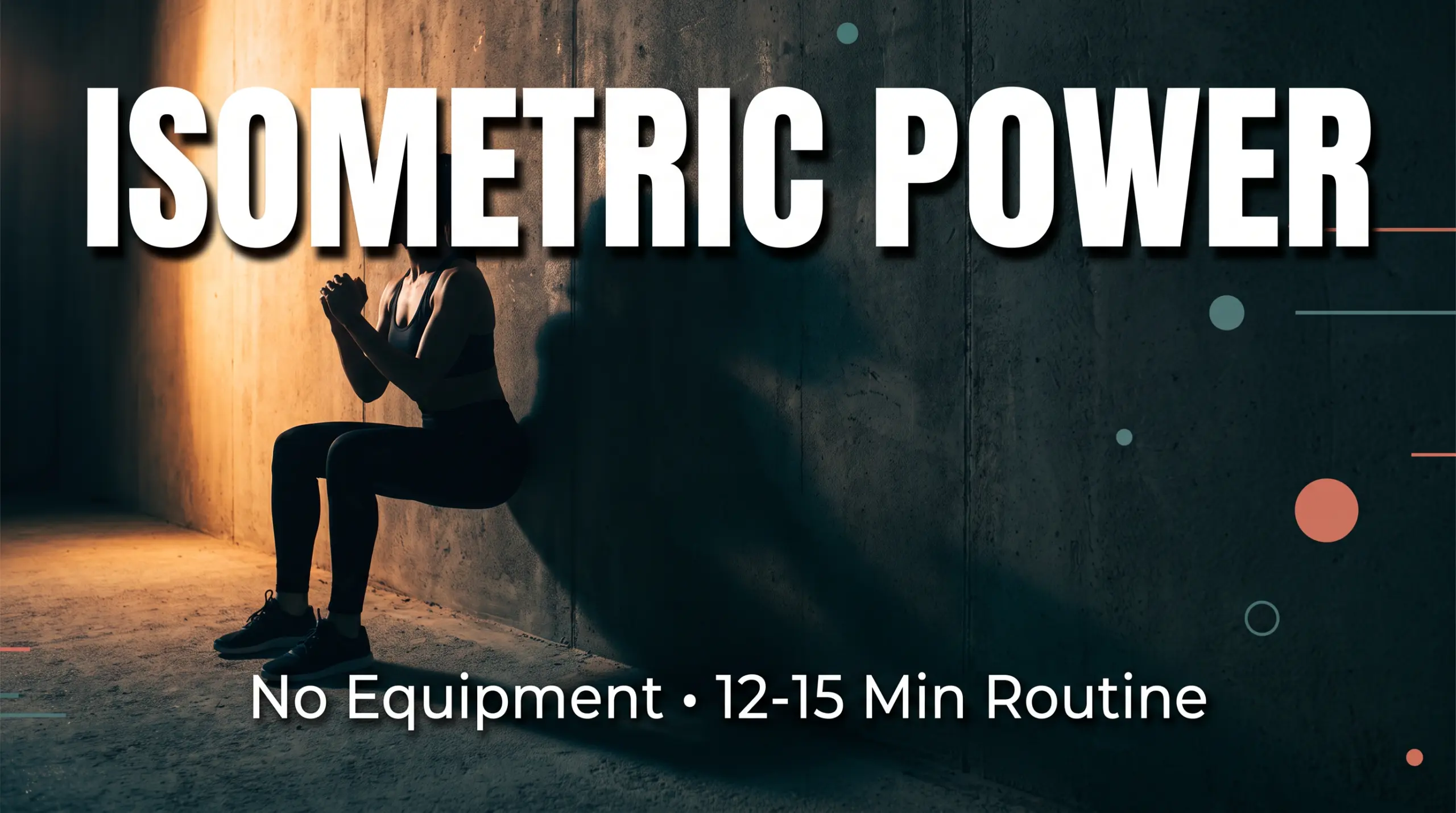
This minimalist routine requires no equipment and can be performed anywhere. It targets every major muscle group in approximately 12 to 15 minutes.
Protocol Guidelines:
- Basics: Hold each contraction for 30-60 seconds. Perform 2-3 rounds, resting 60 seconds between exercises.
- Breathing: Never hold your breath! Inhale deeply through the nose into the belly and exhale smoothly through pursed lips throughout each hold.
- Effort Level: Aim for 70–80% of maximal voluntary contraction on yielding holds, or ramp up to an 85–90% effort for overcoming holds.
- Frequency: Perform 3 to 4 times per week.
Exercise Instructions
1. Wall Sit (Lower Body Push)
- Setup: Place your back flat against a sturdy wall and step your feet out roughly two feet. Slide down until your thighs are parallel (or slightly above parallel) to the floor, with knees stacked over ankles.
- Execution: Press your lower back firmly into the wall and drive your heels straight into the ground. Maintain an upright torso and steady nasal breathing.
2. Isometric Glute Bridge (Lower Body Posterior Chain)
- Setup: Lie on your back with your knees bent and feet flat on the floor, hip-width apart.
- Execution: Drive through your heels to raise your hips until your thighs and torso form a straight diagonal line. Squeeze the glutes and engage the hamstrings. To increase intensity, raise one leg off the ground and maintain a level pelvis on a single leg. Avoid overarching the lumbar spine; initiate and maintain the lock from the glutes and pelvis.
3. Doorway Isometric Chest Press (Upper Body Push)
- Setup: Stand inside a sturdy doorway or hallway. Position your palms against the inside of the door jamb at chest height with elbows bent roughly 90 degrees.
- Execution: Press outward with sustained force into the door frame as if trying to push the walls apart. Focus on contracting your chest, triceps, and anterior deltoids.
- Alternative: If there’s no doorway, you can do a Push-Up Hold instead. Assume a push-up position (modify on knees if needed). Lower yourself halfway down and hold. Keep your body in a straight line from head to heels.
4. Doorframe Isometric Row (Upper Body Pull)
- Setup: Stand facing one side of a doorway. Grip the door trim or frame with both hands (or wrap a sturdy towel around an anchor point).
- Execution: Hinge slightly back at the hips with bent knees and pull your chest toward the frame against the immovable anchor, focusing on driving your elbows back and retracting your shoulder blades.
5. Forearm Plank with Squeeze (Midline & Anti-Extension)
- Setup: Lie prone and elevate onto your forearms and toes. Elbows stacked directly under your shoulders.
- Execution: Rather than passively hanging on your joints, create active tension: actively pull your elbows toward your toes and squeeze your glutes and quads together. Keep your ribcage down and spine neutral, avoiding hip sag or elevation.
6. Superman Hold (Posterior Midline)
- Setup: Lie face down, arms extended overhead. Simultaneously lift your arms, chest, and legs off the floor.
- Execution: Hold the contraction in your lower back. Take it easy if you suffer from lower back pain.
- Alternative: Prone Y-Hold which targets more of the upper back. Lie face down, arms extended in a “Y” shape overhead. Lift your arms off the floor, squeezing your shoulder blades together. Hold the contraction

Measuring and Tracking Progress
Because isometrics lack rep counts, progression is measured through:
- Time Under Tension: Progressing from 20-second holds to 45-second holds while maintaining identical postural alignment.
- Force Output & Rate of Force Development: You can use a digital hand dynamometer or portable force gauge to track force production.
- Resting Cardiovascular Metrics: Tracking resting systolic and diastolic blood pressure over an 8- to 12-week block to monitor vascular improvements.
Integration with Your Existing Routine
Isometric training complements the bodyweight workout routines that I am such a big fan of. No matter what you’re current routine is, isometrics can complement it. Consider using isometrics as:
- Finishers: Add a 30-second hold at the end of your regular sets. I do this all the time particularly with pushups, hammer curls and squats
- Active recovery: On rest days, perform low-intensity isometrics to promote blood flow and force some movement.
- Prehab/Rehab: Address weak points and strengthen tendons before they become problematic areas.
- NEAT: You can make isometrics just a normal part of your day’s ‘exercise snacks’. Some of my favorite ways of doing this is to incorporate a wall sit while brushing my teeth or an isometric calf raise at my standing desk, while pumping gas or standing in line for something.
Even though isometrics require no equipment, they also integrate cleanly with pre-existing home gym setups. For example, trainees who utilize bodyweight gear such as gymnastic rings can perform static support holds and paused pull hangs to build immense shoulder girdle and core stability without requiring bulky commercial machines.
The Bottom Line
Aging is inevitable, but physical decline is not. Isometric exercise represents one of the most efficient, accessible, and research-backed methods for maintaining strength, function, and independence as we age. The combination of superior blood pressure benefits, joint-friendly loading, and proven muscle-building effects makes isometrics a non-negotiable component of any longevity-focused fitness program. Isometric training fits this philosophy perfectly—requiring minimal equipment while delivering maximum results.
Ready to transform your approach to aging? Start with the routine above, and explore our other resources on metabolic fitness and daily rituals for health.
Leave a Reply